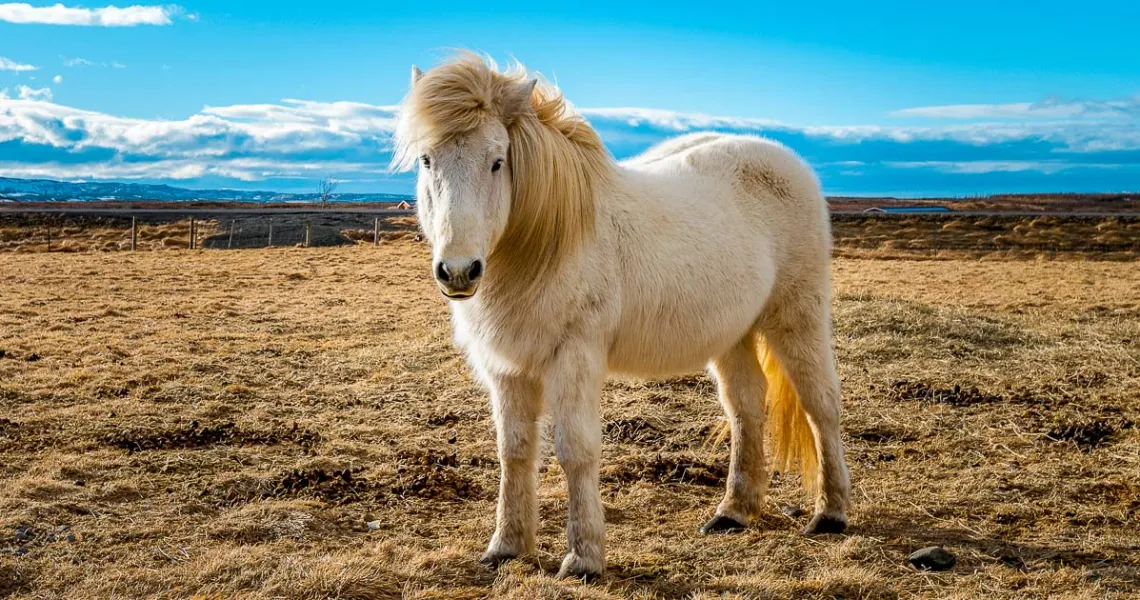
The Icelandic Horse is the breed of horse found in Iceland.
They are known for their hardy constitution, good temperament and sure-footedness.
They have a thick coat of hair which helps protect them from the cold Icelandic weather.
In addition to being used as working horses, they are also popular recreational animals and are often ridden by tourists who visit Iceland.
Icelandic Horse Breed Info
Here are some of the key things you need to know about the Icelandic horse:
| Height (size) | 13.0 – 14.0 hands high |
| Colors | They come in over 40 colors and 100 various patterns, and in Icelandic language there is a word for each and every one! The most common colors are brúnn (brown) and rauður (chestnut), and the rarest one is litföróttur, which translates as ‘color traveler’. |
| Country of Origin | Iceland |
| Common Uses | Equine tourism, traditional sheepherding, general pleasure riding, shows, racing, meat production |
Icelandic Horse Facts & Information (Breed Profile)
Modern Icelandic horses may trace their ancestry back to the first Viking horses brought by the settlers between 860 CE and 935 CE.
Along with the horses, the Norse settlers also brought with them the myths and legends that are associated with the animals.
The long-standing adoration for this breed is documented in Icelandic myths and folklore.
It was never thought of as a servant, but rather as a friend and companion.
In the past, horses were essential to the Icelandic people’s existence, and they were also their most reliable mode of transportation.
Numerous accounts describe riders who were stranded in Iceland’s brutal wilderness during blizzards and their horses either kept them warm until they were rescued or found their own way home, taking the tired rider back to safety.
By the first Iceland book of laws stealing horses was considered a serious crime, and as punishment the offenders were exiled from society and became outlaws.
And in Iceland during the Viking Age, being an outlaw meant you might be lawfully executed on the spot, without any kind of trial.
During those times, there were undeniably very few people who would have had the courage to steal a horse.
Today, you may see these beautiful animals in Iceland’s Ring Road meadows, in the city, and on horse farms.
The Icelandic horse is a must-see attraction for everybody who visits Iceland.
There are no other horse breeds in Iceland, but the Icelandic horse.
Around 80,000 horses live in Iceland today. Icelandic horses have their own naming committee, meaning you cannot name your horse like you would any other pet.
While it might seem strange, it shows how much respect the Icelandic people have for their valuable horses.
Even if the horse isn’t as essential as it once was due to progress in mechanization and general road improvements, horses are still an important part of everyday life for the people of Iceland.
In the Highlands, farmers continue to raise horses for leisure riding and sheep-herding, and since the late 1800s, racing, showmanship, and gaited events have become popular.
Icelanders do consume horse meat, and some horses are bred specifically for that purpose.
The modern Icelandic horse is the product of many centuries of selective breeding.
Throughout history, only the best horses were selected for reproduction based on certain traits, such as color and conformation.
Even though many horses are seen wandering around freely, the population of Iceland’s wild horses is thought to be about one hundred.
All of the others are in fact owned by someone.
Once exported, the Icelandic horse cannot come back to the island.
If you’re interested in learning more about this fascinating breed, keep reading!
Alternative Names
n/a
Temperament/Personality
Mostly friendly and curious, but they can also be stubborn and relentless.
Having no natural enemies in their habitat, these horses are not easily spooked, and like interacting with humans.
Physical Characteristics
Their bodies are compact, the neck is short, and the croup is round.
The mane and tail are thick.
As a result of selective breeding for certain characteristics in different regions, the conformation, size, and temperament of the breed vary greatly.
They have a double coat, which helps them survive harsh Icelandic winters.
They are overall very hardy and able to endure sparse vegetation and long journeys.
Considering their small stature, they can carry a remarkable amount of weight.
All Icelandic horses are gaited, and can perform the tölt, while some are even five gaited and can also do the skeið, also called the ‘flying pace’.
Colors
They come in over 40 colors and 100 various patterns, and in Icelandic language there is a word for each and every one!
The most common colors are brúnn (brown) and rauður (chestnut), and the rarest one is litföróttur, which translates as ‘color traveler’.
These horses literally change colors several times in a year, often resulting in a splattered in-between color.
Some individuals have light blue eyes.
Height (size)
13.0 – 14.0 hands high
Stallions
n/a
Mares
n/a
Weight
730 – 840 lbs (330 – 380 kg)
Blood Type
n/a
Common Uses
Equine tourism, traditional sheepherding, general pleasure riding, shows, racing, meat production
Health
Very hardy and long living
Popular Traits
Their unique gaits – tölt and skeið
Feeding/Diet
n/a
Country of Origin
Iceland
Ancestors
Fjord, Mongolian horse, Tarpan